Website and app development in Nepal.
I build websites and Android apps for Nepali businesses from Kathmandu. Sites load fast on mobile data and are built to be found on Google; apps are made in Flutter and released on Google Play. You talk to me directly on WhatsApp or Viber, and quotes come in NPR.
Message on WhatsAppViberCall +977 9849274961Or book a 30-minute call
Built for Nepal’s phones and networks
Most visitors in Nepal arrive on a phone, often on mobile data. Pages are kept light so they open quickly, and apps are tested on low-end Android phones, as Rhino Dash was.
Found on Google by Nepali students
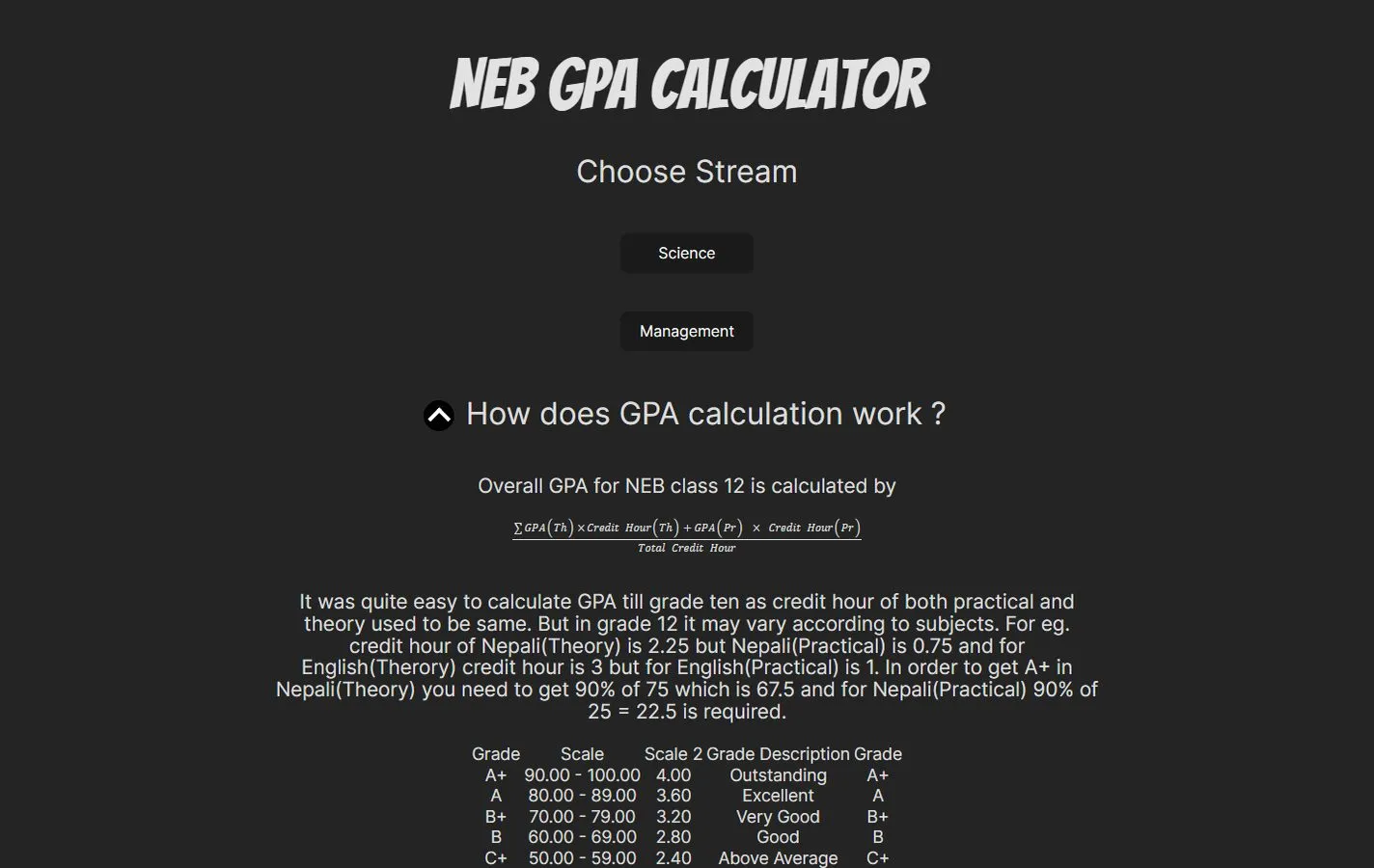
The NEB GPA Calculator I built for Grade 11 and 12 students had 242K Google clicks and 1.38M impressions in the 12 months to July 2026.
Apps from a Nepali team
Rhino Dash, a game set in Sauraha near Chitwan National Park, is live on Google Play, and Dishmo, a food discovery app for the Kathmandu valley, is in development. Both come from Appynox, the agency I co-founded in Lalitpur.
Building websites and apps in Nepal
On this page
- Website development in Nepal: built for phones and mobile data
- Websites for schools, colleges, clinics, travel agencies and NGOs
- Domains and hosting for a Nepali website
- Free web tools that Nepali people use
- Getting found on Google in Nepal
- App development in Nepal: Android first
- How working together runs
- Care after launch
- What decides the cost of a website or app in Nepal
- How to start
Website development in Nepal works best when it starts from the visitor’s phone: a page that opens on mobile data, shows Nepali text correctly, and lets someone call or message you in one tap. App development in Nepal starts with Android, because that is the phone most people here carry. I build both from Kathmandu, as a web developer and a Flutter developer, with Appynox, the agency I co-founded in Lalitpur.
Website development in Nepal: built for phones and mobile data
Most people meet your business on a phone, often on a data pack from Nepal Telecom or Ncell rather than home Wi-Fi. A homepage with a dozen full-size photos and an auto-playing slider can take a long time to open there, and many visitors will tap the next Google result instead.
So I build for the slow case first. Photos are resized for the screens that show them, fonts are kept to the few styles the design needs, and nothing plays by itself. Before launch I test on a low-end Android phone over mobile data.
Website design in Nepal should also fit how people here use the web. For many businesses the Facebook page is the whole online presence. Keep it for your regulars, and let the website be what a new customer finds on Google.
A Nepali-language website that displays correctly
A Nepali-language website needs Unicode text. Older Nepali documents were often typed in legacy fonts such as Preeti. On any phone without that font the text shows as random English letters, and search engines cannot read it as Nepali either. I use Unicode Devanagari only.
Devanagari also needs more vertical room than English, because tight lines clip the marks above and below the letters. I set generous line spacing and use fonts made for the script, such as Noto Sans Devanagari or Mukta.
The Nepali and English versions link to each other, so Google can show each to the right person. Which language leads depends on your customers: English first for a guest house in Sauraha, Nepali first for a coaching centre in Butwal. Someone who writes good Nepali should read every line before launch.
Google Maps, calls, WhatsApp and Viber
A Google Business Profile, the listing that puts you on Google Maps, is often the first thing a local customer sees. Many places in Nepal have no street number, so the map pin does the work of an address. I help you set it on the real entrance. The website then links to it with a directions button.
Each page carries buttons for the way your customers already talk: call, WhatsApp, Viber and Messenger. The WhatsApp button can open with a greeting already typed. Phone links use the full +977 number, so they also work from abroad. When messages arrive faster than one person can answer, that is a job for AI automation for businesses in Nepal.
Online payment with eSewa, Khalti or a bank QR
Does the site need to take money at all? Often not: a restaurant needs a menu, a map and a call button. When it does, for a shop, a fee, a booking or a donation, it uses the wallet or bank QR your business already has, such as eSewa, Khalti or a Fonepay QR.
The simplest version shows your payment QR, and you confirm each payment by hand. A gateway confirms payments automatically: the customer pays on the provider’s page and the site learns the result. eSewa and Khalti issue merchant accounts to the business itself, usually after checking registration papers and a bank account. I follow the provider’s current documentation, test in its sandbox, and make the server check with the provider before it marks an order paid.
An e-commerce website in Nepal
An e-commerce website in Nepal has to fit how Nepali shoppers buy. Many still want cash on delivery, delivery outside the Kathmandu valley is priced differently, and orders are often confirmed by a quick message on Viber or WhatsApp. The order form asks for a phone number and a landmark, because riders often call when they get close.
Start smaller than you think. If you sell a few dozen items and most orders arrive as Instagram messages, a catalogue with an Order on WhatsApp button on each product may be all you need for now. A full shop with stock counts and online payment makes sense once the messages become hard to manage. On the marketplace side, I have built a price-tracker bot for Daraz that runs on Telegram.
Websites for schools, colleges, clinics, travel agencies and NGOs
These sites publish information that changes, and visitors arrive with one specific question. The examples below are illustrations of what I would plan. None is a past client.
Websites for schools and colleges in Nepal
Websites for schools and colleges in Nepal are read by parents and students deciding where to apply, and by enrolled students looking for notices. Applicants need the programmes, the affiliation (NEB, Tribhuvan University, Kathmandu University, Pokhara University or another), fees, scholarships, and admission steps and dates.
Getting into an engineering college here means an entrance exam, a scholarship search and very little guidance. I went through that, and I now run Dimension, a YouTube channel that helps Nepali students get into engineering colleges and find scholarships. So admissions and scholarships get their own pages.
Notices are the other half. Schools often post a photo of a printed notice on Facebook, which search engines cannot reliably read. On the site, each notice is text, dated in Bikram Sambat and in the English calendar, and a staff member adds it from a simple form.
Clinics, travel agencies and NGOs
- Take a physiotherapy clinic in Butwal. Its site should answer four things quickly: what it treats, which doctor is in on which day, where it is and how to book. Forms ask for a name, phone number and preferred time, never health details.
- A trekking agency in Thamel serves Nepali customers and travellers abroad, so the English pages carry the most weight and must open on hotel Wi-Fi as well as on a phone in Europe. I have trekked Langtang, Panch Pokhari and Sailung with a camera, and I would rather use your real photographs than stock ones.
- NGO readers are donors, partners and government offices, and they read carefully. Annual reports and accounts belong on the page as text, not only as scanned PDFs. Projects are listed by district, registration details are visible, and photos of children are used only with consent.
Domains and hosting for a Nepali website
Nepal has separate endings for different owners: .com.np for businesses, .org.np for organisations, .edu.np for educational institutions and .gov.np for government. A .np domain tells customers and Google that you serve Nepal, and my own site is on one, at paudelanuj.com.np. One thing to check first: the registry usually asks for a business registration certificate, so read its current rules before you fix a launch date. If your customers are mostly abroad, a plain .com may suit you better.
For hosting I use Cloudflare Pages, and sometimes Netlify. They serve finished pages from servers close to the visitor, so a rush such as admission season or Dashain shopping is rarely a problem.
Free web tools that Nepali people use
My best proof for building in Nepal is a tool I made for students. In 2024 I built the NEB GPA Calculator for Grade 11 and 12 students, and I have kept it free and light since. It has no ads and no accounts, and it earns me nothing.
Google Search Console shows 242K clicks and 1.38M impressions for the 12 months to July 2026, with a 17.5% click rate and an average position of 6.4. Visits arrive in spikes on results days, exactly when a slow page would fail the students who need it.
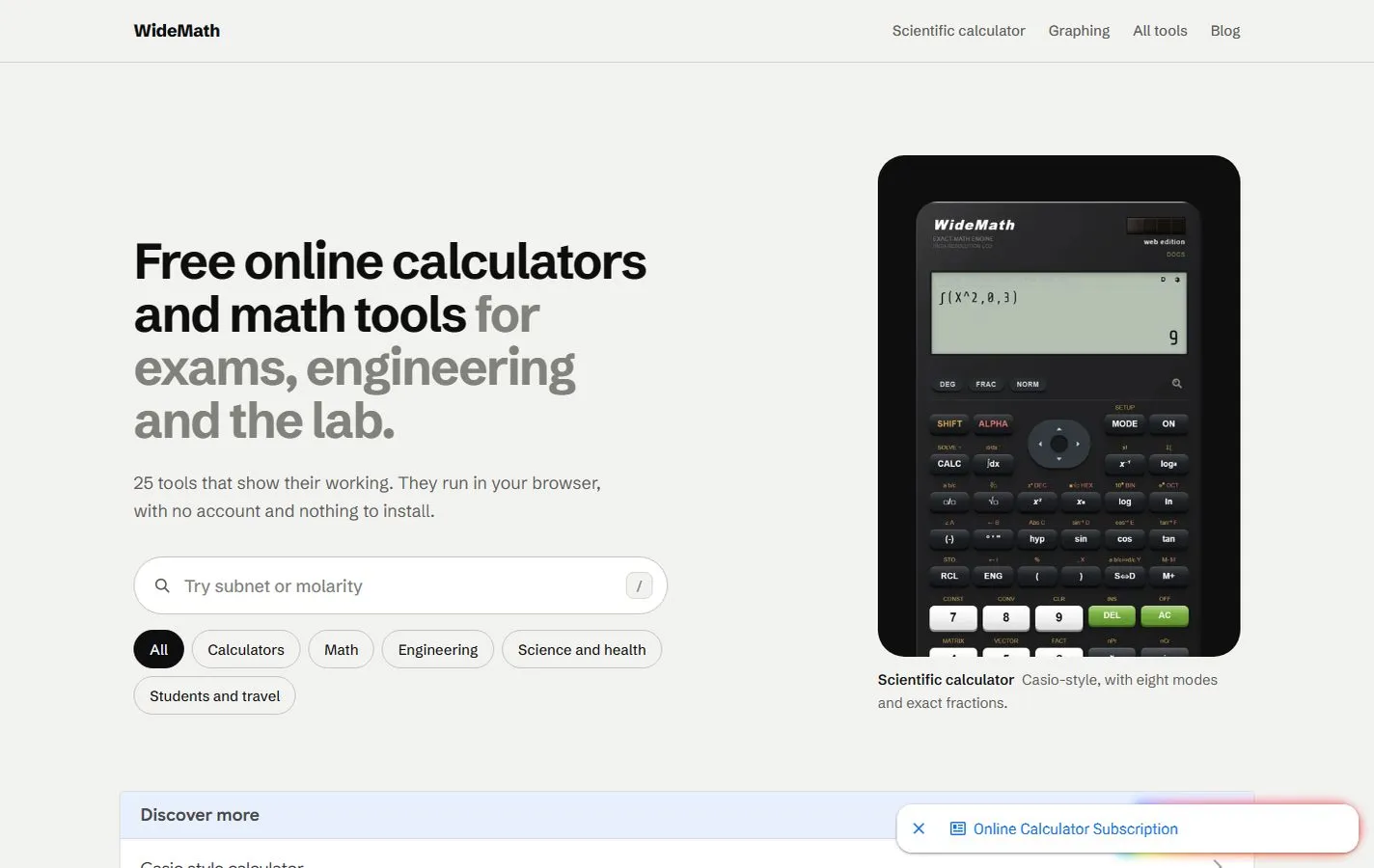
WideMath is the same idea with more tools. We built it at Appynox as 25 free math tools, led by a Casio-style scientific calculator. In one week, 10 to 16 October 2026, it had 19,464 sessions, 73% of them from Google search. We also made GharCalc, free home-loan calculators for buyers in India (ghar is the Nepali and Hindi word for house).
The point for a Nepali business is simple: a small tool that answers one exact question can bring in customers who never saw your Facebook page. A land agent could offer a ropani, aana and square feet converter, and a cooperative a loan instalment calculator.
Getting found on Google in Nepal
An SEO-friendly website in Nepal starts with a clear title and description on every page, headings that match what people search, a sitemap, fast loading, and structured data with your business name, address, phone and hours. I build these in from the first page.
Search habits here are mixed. People search in English, in Devanagari, and in Nepali typed with English letters, like “ghar jagga bikri”. After launch I read Google Search Console to see the exact words that bring visitors, then add what is missing.
Local search adds your Google Business Profile, real customer reviews, and the same name, address and phone number everywhere. I cannot promise a ranking, and nobody honest can, but I can show you what holds a page back. More on the SEO and launch page.
App development in Nepal: Android first
Most phones in Nepal run Android, so an app should start there. I use Flutter, which builds Android and iPhone apps from one codebase, so an iPhone version can follow later. As a Flutter developer in Nepal I also write native code where needed: MoodWave, an offline music player we are building, runs its on-device model through a Kotlin bridge.
Mobile app development in Nepal means planning for phones with little memory and storage, and for connections that drop. I test on low-end Android phones, and before release an app must stay inside budgets for memory, frame time and cold start. A build that misses a budget does not ship. Downloads stay small too, because a heavy app costs real money on a data pack.
Apps built in and for Nepal
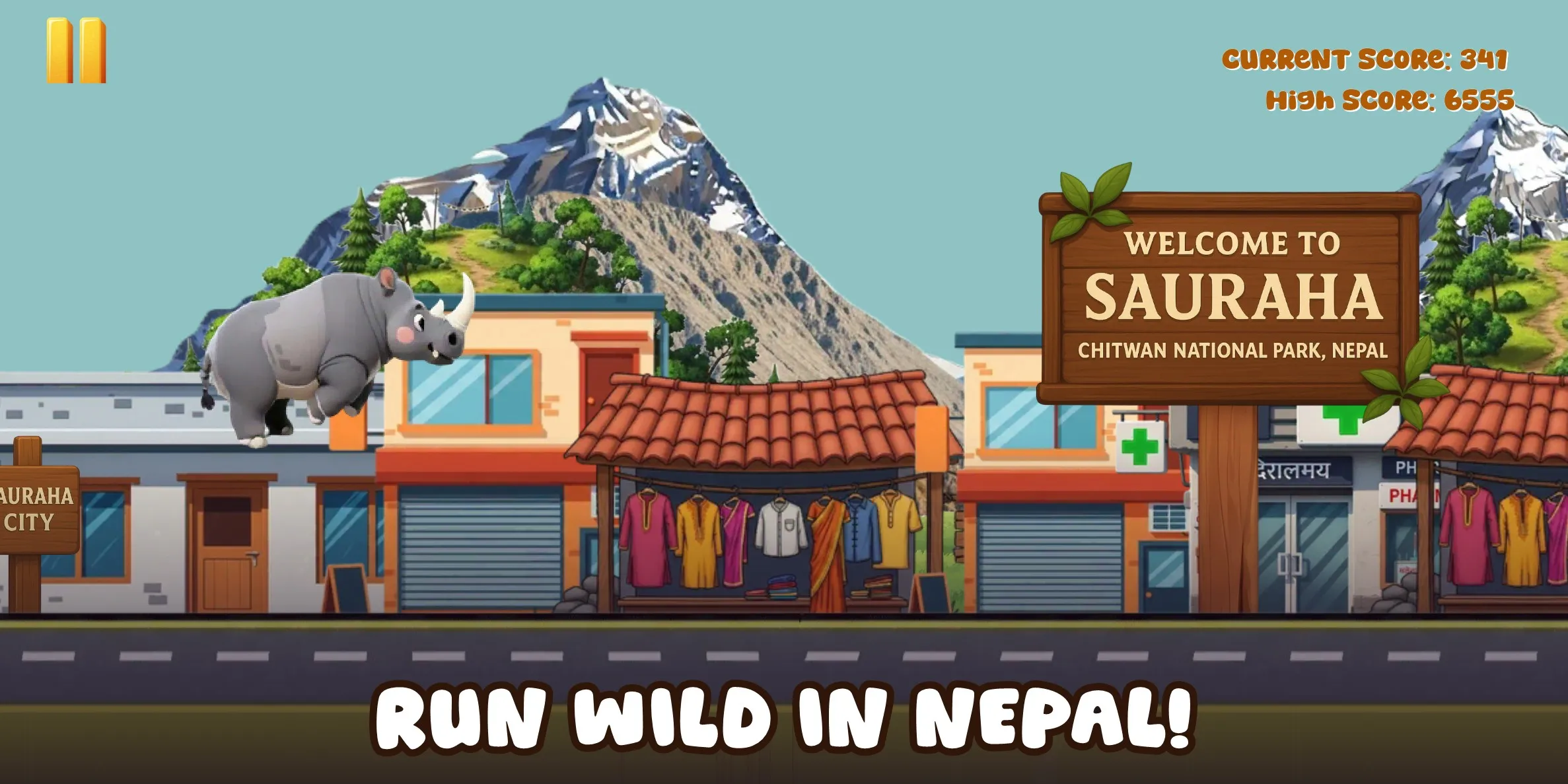
- Rhino Dash is a runner game for young kids, set in Sauraha near Chitwan National Park, with rickshaws and rhinos. Chitwan is where I began making films around 2019. The game is built in Godot, tuned for low-end Android phones, and live on Google Play.
- Dishmo is a food discovery app for the Kathmandu valley, now in development.
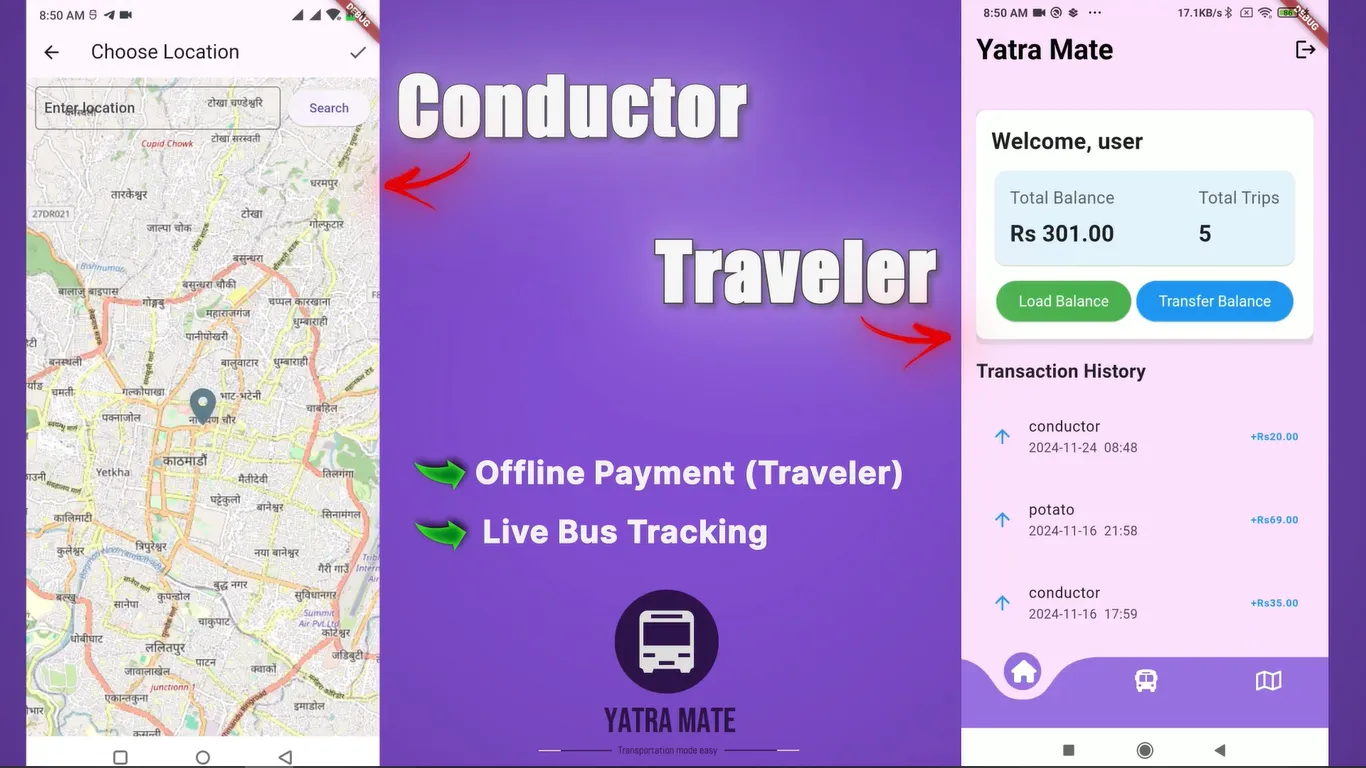
- YatraMate lets a passenger pay a bus fare by scanning a QR code instead of handing over cash. We built it in 48 hours at KU HackFest 2024, so it is a prototype.
- OffNet lets nearby phones chat and share files with no internet at all. It is also a prototype.
How an app gets built
Every app starts as a written spec with a reason to exist, plus notes on screens and rules before any code. I build in rounds: AI agents help draft and test the code, and I review the work at set checkpoints.
You install test builds on your own phone as the app grows. Then come the Google Play listing, with an icon, feature graphic and screenshots from a composer I built myself, closed testing, release, and fixes from real feedback. If the app needs accounts or data, I build the backend too. The app development page has the wider picture.
How working together runs
WhatsApp and Viber both reach me directly at +977 9849274961, and a call works too. As a web developer in Kathmandu, I can meet you in person in Kathmandu, Lalitpur and Bhaktapur. Everywhere else, including Pokhara, Chitwan, Biratnagar and Butwal, video calls do the job.
- I send a written plan and a quote in NPR that lists what is included, so any later change is agreed with you first.
- You see working versions as we go: a preview link for a website, a test build on your own phone for an app.
- At launch the domain, hosting, code and content are yours, and I show your team how to publish.
Care after launch
A website is not finished at launch, and an app even less so. For a website the routine work is small: renew the domain, keep opening hours and holiday notices current (a Dashain or Tihar closure belongs on the homepage), and check that the call, WhatsApp and Viber buttons still work.
Apps need more. Android changes every year, and an app left alone for long can stop being offered to new users on Google Play. I can handle updates and fixes from reviews on a regular schedule, or hand you a written list so another developer can.
What decides the cost of a website or app in Nepal
I do not quote from a price list, because two sites with the same number of pages can need very different amounts of work. What moves the cost:
- Five pages are less work than fifty, and it matters who writes the text and takes the photos.
- A Nepali and English site means two sets of text, each checked by someone who reads the language, and a design that works for both scripts.
- An information site is the simplest. Online payment, booking, a shop with stock, member logins or a link to your billing software each add design, building and testing.
- For an app: the number of screens, whether it needs accounts and a backend, offline use, iPhone as well as Android, the store listing, and how many phones it is tested on.
- After launch there is the yearly domain renewal, any paid services such as SMS, and my time if you want me to look after the site or app.
The quote comes in NPR after a short call and lists what is included. A smaller first version is often the better start. For a bigger build, Appynox takes it on with a team of three.
How to start
Message me on WhatsApp or Viber at +977 9849274961, or book a 30-minute call. Tell me what the business does, who your customers are and what you already have: a Facebook page, a logo, photos, a domain. You get a written plan and a quote in NPR, and you decide after that. If you are outside Nepal, the website development page describes the same work.
Questions from Nepali businesses
How much does a website cost in Nepal?
It depends on the pages and features you need. After a short call you get a written quote in NPR.
Can you build an Android app for my business?
Yes. Apps are built in Flutter, so an iPhone version can follow from the same code.
Will Nepali customers find my site on Google?
Every page is built with the structure Google reads. The NEB GPA Calculator shows what that can do for a Nepali audience.
Can I update the website myself?
Yes. Sites that change often come with a simple editor for posts and pages.
Outside Nepal, or want the full picture? See Website development, or every service in Nepal.
Message me, or book a call.
WhatsApp and Viber reach me fastest. Tell me what your business needs; you get a written plan and a quote in NPR.
Referred by someone? Mention them when you book.